


Stop letting your operators play a dangerous guessing game 30 feet in the air. In the warehouse world, what you can’t see will cost you—often exceeding $200,000 in a single major incident.
Read this guide to discover how a simple visual upgrade can slash your product damage by 85% and supercharge your warehouse throughput by 27%.
Wondering if you can actually stop warehouse accidents before they happen?
The answer is almost certainly a resounding “Yes”.
But here is the thing: Most facilities are still operating with a “hope and a horn” strategy. They rely on rearview mirrors and operators who are physically unable to see through the massive blind spots inherent to heavy machinery.
In today’s high-velocity logistics environment, visibility isn’t just a convenience—it is the fundamental currency of safety. As supply chains accelerate and warehouses become denser, your margin for error is shrinking every single day.
If terms like “Latency,” “AI human detection,” and “IP ratings” give you a thumping headache, don’t worry. By the end of this guide, you’ll have a clear roadmap for implementing a zero-accident culture that actually puts money back in your pocket.
Let’s jump right in.
Key Takeaways: Why Visibility is an Investment, Not a Cost
Stop the Blind Driving: Realize that operators aren’t negligent; they are often physically unable to see.
The Mirror Myth: Understand why traditional mirrors fail in the modern warehouse.
AI vs. RFID: Learn which detection technology fits your specific traffic flow.
Wireless ROI: Discover how removing mast cables can cut maintenance costs by 45%.
Cultural Shift: See how driver buy-in is the secret to a successful rollout.
Before we get into complex sensor networks, we need to address the core component of modern safety: the camera system.
For decades, operators drove “blind,” but those days are over.
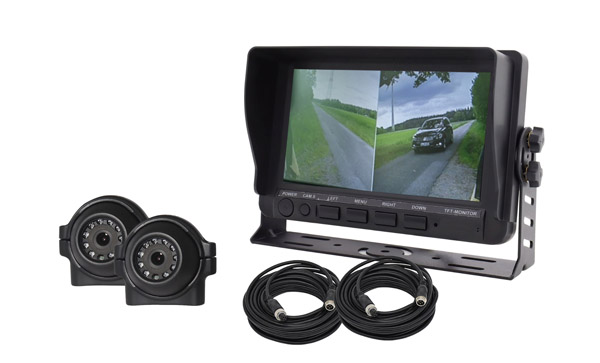
A robust safety system is not just a GoPro strapped to a roll cage. It is an integrated circuit of industrial hardware designed to withstand constant vibration and 10G shocks.
What actually makes up a modern system?
The Optic Unit
You need high-definition cameras with Wide Dynamic Range (WDR). Why? Think about your operators moving from a dark trailer into a bright, sunny loading dock. Without WDR, the screen “whites out,” and for a few critical seconds, they are driving blind again. You need optics that adjust as fast as the human eye—actually, even faster.
The Monitor
You need industrial-grade screens with zero latency. Think about it: If the video on the screen lags by even half a second, the safety benefit disappears.

At 5mph, a forklift travels several feet in that half-second. Your operator needs a real-time feed, not a “slideshow” of what happened behind them two seconds ago.
The Cabling and Transmission
This is the “nervous system” that gets the signal from the carriage to the cab. Choosing the right setup can be daunting. Do you need a simple rear-view backup camera, or a 360-degree bird’s-eye view? Is a wired connection feasible, or does your operation require digital wireless transmission?
But here is the kicker: Most managers ask, “Neil, why aren’t mirrors enough?”
Mirrors have a critical flaw: they require the operator to look away from their direction of travel or the load. Furthermore, mirrors cannot see through the mast structure or around large, bulky pallets. A camera system keeps the operator’s eyes forward and ergonomic, reducing the neck strain and fatigue that are hidden contributors to accidents.
The Human Factor — Protecting Pedestrians
The most devastating accidents in any warehouse involve pedestrians. The interaction between a 5-ton vehicle and a human being is never a fair fight.
But here is the deal: Implementing a strategy for forklift pedestrian safety involves more than just buying gadgets; it requires a holistic approach. You need to combine your traffic management plans with active alert systems.
When operators receive an audible or visual alert that a pedestrian has breached the safety zone, their reaction times are significantly improved. It moves from a “passive” safety environment to an “active” one where the machine helps the human make the right decision.
Wait, it gets better: This isn’t just about saving lives (which is obviously priority #1). It’s about productivity. When pedestrians feel safe because they know the forklifts “see” them, the entire floor moves with more confidence. You eliminate the “hesitation gaps” that slow down your throughput.
AI Vision vs. RFID Tags
As the industry moves toward automation and active assistance, you are often presented with two competing technologies for proximity detection: Artificial Intelligence (AI) and Radio Frequency Identification (RFID). Both technologies aim to stop forklifts from hitting people, but they achieve this via vastly different mechanisms.
RFID: The Tag-Based Approach
RFID safety systems work on a “handshake” protocol. The pedestrian wears a tag (usually in a vest or on a lanyard), and the forklift is equipped with a reader. When the two get close, an alarm sounds.
- The Pros: It can detect people through walls or around blind corners where there is no line-of-sight.
- The Cons: It relies on strict compliance. If a worker forgets their tag, or if a delivery driver enters your facility without one, the system is “blind” to them.
AI Cameras: The Vision-Based Approach
AI detection uses machine learning algorithms embedded in the camera itself. It doesn’t look for a tag; it looks for a human shape.
- The Pros: It detects everyone, tag or no tag.
- The Intelligence: Modern AI systems can distinguish between a human and a static object like a traffic cone. This is huge. If your system beeps every time it sees a box, your drivers will eventually ignore the alarm. AI makes sure the alarm only sounds when it actually matters.
Overcoming the “Mast View” Blind Spot
One of the most persistent challenges in forklift operation is the “Mast View.” As forklifts have evolved to reach higher racking (sometimes over 30 feet), the mast structure has become wider and more complex to support the weight.
This creates a “Carriage Blind Spot.” When your operator picks up a pallet at height, they are essentially guessing. They cannot see if the forks are perfectly aligned with the pallet pockets. Misalignment leads to:
- Punctured Inventory: Forks stabbing your product.
- Tip-overs: Unbalanced loads falling from height.
- Racking Damage: Pushing pallets into the structure.
The Secret? Installing a camera directly on the carriage (between the forks) solves this. It gives the operator a “fork-level view” on their monitor.
But there’s a problem: Running a cable from the dashboard, up the mast, and down to the carriage puts immense strain on the wire. Constant extension and retraction lead to cable wear, “internal kinking,” and signal failure.
The Wireless Solution: Modern wireless cameras use stable digital signals to transmit video without the need for complex cable reels over the mast. These systems are easier to install and even easier to maintain. Switching to wireless can reduce your unplanned maintenance costs by 45%. That is real money back on your balance sheet.
The Cold Storage Challenge
Standard electronics die in the deep freeze. If you operate in refrigeration units, you have two major enemies: fogging and icing.
When a cold forklift moves into a warmer loading dock, the lenses fog up instantly. This is more than just an annoyance—it’s a safety hazard.
The Solution: You need specialized “Cold Store” cameras with internal heating elements. These heaters serve two purposes:
- They keep the internal electronics at an operating temperature.
- They warm the lens glass to prevent fogging and icing.
What to look for: Ensure the casings are made of stainless steel to resist corrosion from the moisture inherent in these units. Also, check the IP (Ingress Protection) rating. You need a system that seals out moisture completely while being powerful enough to maintain clarity without draining the forklift’s power source excessively.
Implementation Strategies and Best Practices
Buying the hardware is only step one. For a successful rollout, you need a cultural shift within your warehouse.
- Driver Buy-In
Drivers often resist cameras, fearing they are being “spied on” (telematics). It is crucial to position these systems as assistive tools, not surveillance tools. Think about it: Show them how the monitor stops them from twisting their back or straining their neck 40 times a shift. When operators realize the system makes their job easier and less physically demanding, adoption rates soar.
- Monitor Placement
Where you put the screen matters.
- Too High: Blocks forward visibility.
- Too Low: Forces the driver to look down, losing peripheral vision. The “sweet spot” is usually on the front pillar, in the same visual plane as the side mirror.
- Routine Maintenance
A dirty lens is as bad as a blind spot. Integrate “lens cleaning” into your daily pre-shift OSHA inspections. It takes five seconds, but it ensures the system actually works when it’s needed.
Implementation Strategies and Best Practices
The next generation of safety systems doesn’t just beep when a person is detected; it interacts with the forklift’s ECU (Electronic Control Unit).
The Active Control Strategy
- Zone 1 (Warning): The camera sees a person 5 meters away, and the alarm sounds.
- Zone 2 (Action): If the person is 2 meters away, the forklift automatically throttles down to creep speed or applies the brakes. This removes human error from the equation entirely.
Cloud Telematics and Data
Managers can now access data regarding “near misses.” Instead of waiting for an accident to generate a report, the camera system logs every time a pedestrian detection event occurs.
The result? This creates a “heat map” of your warehouse. You can identify high-risk intersections that need physical barriers or a traffic flow redesign before someone gets hurt. Safety becomes quantifiable and trackable.
Conclusion: Visibility is an Investment, Not a Cost
The cost of a single forklift accident—in terms of workers’ compensation, inventory loss, racking repairs, and OSHA fines—dwarfs the cost of equipping your fleet with a proper vision system.
Whether you are running a high-speed distribution center, a cramped manufacturing floor, or a sub-zero cold storage facility, visibility is the strategic route to a zero-incident culture.
Are you ready to turn your warehouse into a safety-first profit machine?
Don’t wait for a “near-miss” to become a headline.
What do you think? Which of these challenges is your biggest headache right now—pedestrian safety or high-rack inventory damage?
Leave a comment below and let me know. I personally read and respond to every single one!
Any Questions? (I’ve Got Answers)
I get it. You’re busy running a warehouse, and the last thing you want is another complicated tech gadget that breaks in three months. But after helping thousands of logistics leaders, I’ve heard it all.
Here is the truth:
Most of your concerns about forklift camera systems actually stem from experience with “consumer-grade” junk. Industrial systems are a completely different animal.
Let’s dig into the questions I hear most often.

Article by: Eason He
Eason He
Kocchi’s product manager Eason brings his technical expertise to help explain vehicle safety products in an easy to understand fashion. Eason loves sharing his knowledge of the vehicle camera system and technology insights. He is the part of Kocchi’s team that knows ‘all the things’. He’s good at sharing his technical knowledge so you can benefit. BTW, he is an avid Lego fan!
Kocchi’s Vehicles Camera Systems & Fleet Management
Manufacturing world-class commercial vehicle camera systems, dealers and customers throughout the world choose Kocchi’s products to protect people in transit and transportation. Our award-winning solutions are trusted by more than 1000+ companies and organizations across the world.
What Customers Are Saying About Us…
“Great products, very knowledgeable reps that either have the answer when questioned about products or get you the answer quickly. My rep knows the product very well and is always willing to help. Wish we all had more employees like her. Been doing business with her for many years.” – Robert
“Our experience with Kocchi’s products has consistently been outstanding. The entire process is seamless, well-coordinated, and effortless, from beginning to end. We deeply appreciate the exceptional service provided throughout. Thank you.” – Nick


Leave A Comment