


High-rack operations above 30 feet create a visual gap that manual intuition cannot solve. The mast-mounted wireless forklift cameras have become an essential safety standard by providing the precision needed to eliminate blind spots and protect high-value warehouse infrastructure.
Wondering if you can actually stop a $10 million lawsuit before it even hits your desk?
Most fleet managers and business owners are operating in a high-stakes environment where the margin for error has never been thinner.
You aren’t just fighting rising fuel costs or the constant headache of driver shortages. You are fighting a war in the courtroom.
We are seeing the rise of what the industry calls “Nuclear Verdicts”—lawsuits where jury awards are surpassing $10 million.
It is no longer sufficient to simply trust your drivers. In an accident, without concrete evidence, the semi-truck driver is almost invariably blamed, regardless of the facts.
This presumption of guilt can cost you your reputation, your insurance coverage, and ultimately, your entire company’s existence.
This is where commercial truck camera systems transition from being a “nice-to-have” accessory to a mission-critical operational asset.
In this guide, we are going to dismantle the misconceptions surrounding fleet video telematics, explain the critical integration of GPS and camera technology, and prove why a robust monitoring system is the single highest-ROI investment your fleet can make in 2026.
Let’s jump right in.
One of the most common mistakes I see in fleet safety management is the procurement of consumer-grade electronics for industrial applications.
A fleet manager might browse Amazon, see a highly-rated dash cam for $100, and decide to outfit their entire fleet to save money. Six months later, half the units have failed, and the other half miss critical footage when it matters most.
There is a massive difference between a “gadget” and “industrial equipment.” A standard camera cannot survive in a company truck or a heavy-duty hauler.
Here are the three reasons why:
The Vibration Reality
A semi-truck is a violent industrial environment.
The suspension stiffness, combined with thousands of miles of highway driving, creates a vibration frequency that literally destroys consumer electronics.
Standard soldering points inside cheap cameras micro-fracture under this constant stress.
This leads to intermittent power failures or, even worse, corrupted video files that won’t open when you need them as evidence.
Enterprise-grade commercial truck camera systems are built to SAE (Society of Automotive Engineers) standards.
They utilize reinforced casing and shock-mounted internals designed to withstand G-forces that would shatter a plastic dash cam into pieces.
Temperature Extremes
Your trucks aren’t just driving; they are sitting in extreme conditions.
A truck parked in an Arizona distribution center in July can reach cabin temperatures exceeding 140°F (60°C). Conversely, a truck overnighting in Minnesota can freeze solid.
Consumer cameras use lithium-ion batteries.
These batteries swell and fail in high heat, and they lose voltage instantly in the cold. Enterprise systems utilize supercapacitors.
These are heat-resistant and ensure the camera has enough power to save the final video file even if the truck’s power is cut instantly during a major collision.
Storage Integrity: The SD Card Fallacy
In a consumer setting, if an SD card fails, you lose a video of a scenic weekend drive.
In a commercial setting, if an SD card fails during an accident, you lose your defense in court.
Consumer cameras rely on “loop recording” on local SD cards. These cards have a limited number of “write cycles.” In a truck running 10-14 hours a day, a standard SD card will burn out in months.
Furthermore, in a severe accident, the physical card can be destroyed or ejected from the unit.
Commercial truck camera systems use a hybrid approach: industrial-grade local storage combined with automatic cloud uploading.
When a G-sensor triggers an event, like hard braking, an impact, or a rollover—that specific clip is immediately locked and transmitted to the cloud via 4G/LTE.
Even if the truck burns down, the footage is already safe on your server, ready for your legal team.

Integrating GPS and Camera for Truck
Video tells you what happened. Telematics tells you why and how.
A standalone video clip might show a car swerving in front of your truck.
But a plaintiff’s attorney will still argue, “Your driver was speeding, so he couldn’t stop in time.” Without data, it is your word against theirs. This is why the modern standard is the integration of GPS and camera for truck units.

By combining visual data with telemetry, you create a synchronized data stream that is virtually irrefutable in court.
A fully integrated system provides a “heads-up display” of data overlaid directly on the video playback.
a. Precise Speed vs. Speed Limit: The system records your truck’s actual speed alongside the posted speed limit of that specific road segment. Proving your driver was doing 55 mph in a 65 mph zone instantly dismantles a “reckless driving” accusation.
b. Braking and Throttle Input: Did the driver react instantly? Telematics data can show the exact millisecond the brakes were applied. If the data shows your driver braked 1.5 seconds before impact, it proves attentiveness and eliminates claims of “distracted driving.”
c. Signal Usage: Connection to the truck’s ECU (Engine Control Unit) allows the camera system to log indicator usage. This proves your driver signaled their lane change legally and followed all safety protocols.
d. Geofencing and Location: GPS data confirms exactly where the vehicle was at all times. This validates logbooks and prevents “out-of-route” usage of the company truck, saving you money on fuel and unauthorized wear and tear.
Turning a Cost Center into a Savings Generator
Many business owners view cameras as an expense. They look at the sticker price and see a drain on their budget.
But here is the kicker. When you analyze the Total Cost of Ownership (TCO), a commercial truck camera system is a savings generator.
The Return on Investment (ROI) typically manifests in three distinct areas that directly impact your bottom line.
1. Exoneration and Litigation Savings
The average cost of a commercial truck injury settlement sits between $150,000 and $450,000.
If a camera system exonerates your fleet in just one false claim over five years, the system has paid for itself 100 times over.
Imagine this scenario: A passenger car cuts off your truck and “brake-checks” the driver, causing a rear-end collision.
Without a camera, the law usually presumes the rear vehicle (the truck) is at fault.

You pay the deductible, your premiums skyrocket, and you face a years-long lawsuit. With a camera, you email the MP4 file to the police and the insurance adjuster right at the scene. The other driver is cited, and you pay $0.
2. Lowering Insurance Premiums
Insurance carriers are bleeding money due to nuclear verdicts. They are desperate for clients who actively manage risk.
By implementing a recognized truck camera monitoring system, you demonstrate proactive fleet safety.
Here is the secret to negotiation leverage. Do not just install the cameras; show your broker how you use them.
Show them that you utilize the “Driver Scorecards” to coach your team.
Many carriers now offer subsidies for hardware installation or direct premium discounts ranging from 5% to 15%.
Furthermore, cameras are your only defense against “swoop and squat” staged accidents organized by fraud rings.
3. Operational Efficiency
Have you ever heard of the “Hawthorne Effect”?
It states that people improve their behavior when they know they are being observed.
• Fuel Economy: Drivers with cameras tend to speed less and idle less. A reduction in speeding can help your fuel efficiency by 7-10%.
• Maintenance: Gentle driving extends the life of your brake pads and tires. This reduces your long-term maintenance costs and keeps your trucks on the road longer.
Advanced Features for the Modern Fleet: AI and Total Visibility
The newest generation of commercial truck camera systems is moving from being reactive (recording what happened) to being proactive (preventing it from happening).
The Power of Edge AI
New systems utilize Edge AI—Artificial Intelligence processed right on the device.
Driver Monitoring Systems (DMS) are the front line of defense.
While road-facing cameras record the accident, cab-facing cameras prevent them.
Using facial recognition and eye-tracking technology, AI cameras can detect:
• Fatigue/Drowsiness: The system tracks metrics like eyelid closure rate (PERCLOS) and head nodding.
• Distraction: It can automatically detect cell phone usage, smoking, or a driver looking away from the road for extended periods.
• Seatbelt Compliance: Automatically flagging drivers who aren’t buckled up.
When these behaviors are detected, the system issues an in-cab audio alert (e.g., “Please focus on the road”) to correct the behavior in real-time, while simultaneously flagging the event for the fleet manager to review later.
Multi-Camera Views for Total Visibility
For large semi-trucks, a single front view is insufficient. A complete safety suite often includes:
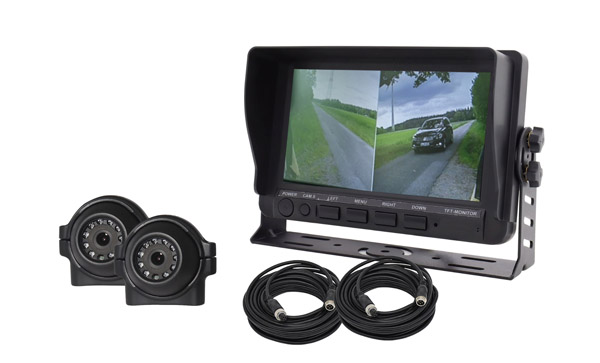
• Side-View Cameras: Mounted on the mirrors to cover blind spots during lane changes.
• Rear-View Backup Cameras: Essential for dock operations. While wireless integration has made installing a backup camera on a truck easier, wired systems are still preferred for commercial reliability to prevent signal lag.
• Cargo Cameras: Monitoring the load to prevent theft or verify that the load is secured properly.
Pedestrian and VRU Detection Technology
While highway safety is critical, the “last mile” is where the most heartbreaking—and legally expensive—accidents occur. I’m talking about collisions with Vulnerable Road Users (VRUs): pedestrians, cyclists, and scooter riders.
In dense urban settings, a truck’s blind spot is a death trap. Heavy vehicles are responsible for a staggering 1 in 5 VRU fatalities.
AI Vision vs. Legacy Proximity Sensors
For years, we relied on simple sensors that just beeped. But in a noisy city or a busy warehouse, those beeps are easily ignored.

Here is the 2026 breakthrough: AI Pedestrian Detection has graduated to intelligent behavioral analytics.
-
Tag-Free Protection: Unlike legacy RFID systems that require workers to wear a badge, AI protects everyone—even if they are crouching, kneeling, or wearing non-reflective gear.
-
99%+ Accuracy: Modern AI models distinguish between a human and a static object like a traffic cone, reducing the “false alarm fatigue” that causes drivers to disable the system.
-
The “Zero Latency” Lifesaver: A human takes roughly 1.5 seconds to react. Edge AI processes that data and triggers an alert in 0.02 seconds. At 5 mph, that extra time saves over 10 feet of reaction distance.
The Multi-Modal Strategy: AI + mmWave Radar
In environments with high dust, fog, or torrential rain, standard cameras can lose up to 60% of their accuracy. The Secret? Integrating AI vision with 77GHz Millimeter-Wave (mmWave) Radar. This combination allows the system to identify the shape (AI) and the exact distance (Radar) with 98.5%+ accuracy even when the driver is functionally blind.
ROI of Pedestrian Protection
Installing AI cameras isn’t just about safety; it’s a massive financial lever.
-
35% Premium Reduction: Many commercial insurance providers now offer reductions of up to 35% for fleets using automated proximity detection and AI safety tools.
-
Regulatory Compliance: New regulations like the EU GSR (R151/R159) are making these systems mandatory for new heavy vehicles. In Australia, CLOCS-A compliance is already becoming a requirement for government projects.
How to Choose the Right System
If you are in the market for commercial truck camera systems, use this checklist to vet potential vendors.
Do not get distracted by flashy marketing; focus on these core B2B requirements :
1. Is it Cloud-Native? Does the system upload footage automatically? If you have to manually retrieve SD cards from trucks that are cross-country, the system is useless for effective management.
2. Resolution and Frame Rate: You need at least 1080p resolution to read license plates clearly. Frame rate (FPS) is equally important; 30fps is standard, but 60fps provides smoother slow-motion analysis during high-speed incidents.
3. Night Vision Capabilities: Accidents often happen at night or in unlit distribution yards. Ensure the hardware uses high-quality Infrared (IR) sensors.
4. ECU Integration: Can the system talk to your truck’s computer? Logging signal usage and braking data is what wins court cases.
Final Thoughts
Commercial truck accidents are bad for everyone involved—the driver, your business, and your community.
But the financial fallout doesn’t have to be your story.
Relying on “off-the-shelf” gadgets or “gut feelings” is a legacy approach. In 2026, a robust truck camera monitoring system is an investment in your company’s survival.
It protects your drivers, shields your assets, and puts you in the driver’s seat of your fleet’s financial future.
Are you ready to turn your fleet into a safety-first profit machine?
Don’t wait for a “nuclear verdict” to become your headline.
What do you think? What is the biggest risk your fleet faces right now, fraudulent claims or rising insurance costs?
Leave a comment below and let me know.
P.S. If you want my team to help you audit your fleet safety tech and find the ROI-driven solutions for your specific business, click here to book a free strategy consultation.

Article by: Eason He
Eason He
Kocchi’s product manager Eason brings his technical expertise to help explain vehicle safety products in an easy to understand fashion. Eason loves sharing his knowledge of the vehicle camera system and technology insights. He is the part of Kocchi’s team that knows ‘all the things’. He’s good at sharing his technical knowledge so you can benefit. BTW, he is an avid Lego fan!
Kocchi’s Vehicles Camera Systems & Fleet Management
Manufacturing world-class commercial vehicle camera systems, dealers and customers throughout the world choose Kocchi’s products to protect people in transit and transportation. Our award-winning solutions are trusted by more than 1000+ companies and organizations across the world.

What Customers Are Saying About Us…
“Great products, very knowledgeable reps that either have the answer when questioned about products or get you the answer quickly. My rep knows the product very well and is always willing to help. Wish we all had more employees like her. Been doing business with her for many years.” – Robert
“Our experience with Kocchi’s products has consistently been outstanding. The entire process is seamless, well-coordinated, and effortless, from beginning to end. We deeply appreciate the exceptional service provided throughout. Thank you.” – Nick


Leave A Comment