


As we move into 2026, the gap between standard warehouse tech and freezer-rated safety equipment is widening. In cold storage, “good enough” visibility is a recipe for catastrophic liability.
Standard forklift camera systems simply aren’t built for the -30°C freezer reality, where thermal shock causes instant condensation and internal short-circuits.
Read this latest technical blog to understand the physics of failure and how to keep your fleet moving safely through the frost.
In the high-velocity world of the global cold chain, visibility is the primary safety barrier standing between operational efficiency and catastrophic liability.
Standard forklift camera systems might be common in ambient warehouses, but they face a near-total failure rate when subjected to the thermal shock of a -30°C freezer.
Safety data confirms that transportation and material moving occupations still account for the highest number of fatal work injuries in the industrial sector.
In fact, forklifts are responsible for nearly 70 deaths and 25,000 non-fatal injuries every single year.
These risks are significantly amplified in cold storage by environmental “blinding” events.
This guide offers an exhaustive technical analysis of exactly why standard hardware fails in sub-zero conditions.
The most immediate point of failure for a forklift safety camera in cold storage is the transition between temperature zones.
The Dew Point Formula
When a forklift transitions from a +5 degree refrigerated dock to a -30 degree deep-freeze unit, the camera lens temperature frequently drops below the dew point of the surrounding air.
This rapid temperature shift causes condensation to form an opaque frost layer, rendering the camera functionally useless within seconds.
Vacuum Effect and Internal Failure
Standard consumer-grade cameras typically rely on simple air-filled housings.
As temperatures plummet, the air inside the unit contracts, creating a vacuum effect that pulls moist ambient air through the seals.
This moisture leads to internal condensation capable of short-circuiting the CMOS sensor or causing permanent lens ghosting.
Data confirms that thermal cycling in these high-humidity environments accelerates the failure rate of unsealed components by over 400%.
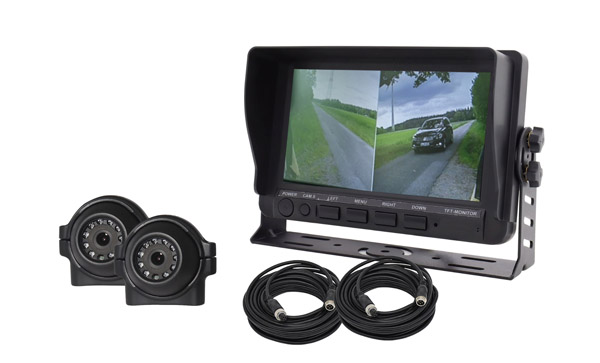
The In-Cab Monitor: Preventing Ghosting and Liquid Crystal Freezing
The Hidden Safety Risk of In-Cabin Display Failure
A critical but often overlooked safety risk involves the failure of in-cabin displays.
Standard LCD monitors are generally designed to operate above 0 degree. Subjecting them to cold storage leads to immediate operational hazards.
Ghosting and Response Time Latency
At temperatures below -10 degree, the liquid crystal molecules within a standard display become sluggish.
This causes the response time to slow down sharply.
The result is severe “ghosting” or image dragging, where a moving pedestrian appears as a blur.
In a high-speed warehouse environment, this visual lag prevents an operator from identifying collision risks in real time.
Integrated Heating Film Technology
To ensure compliance with freezer-rated equipment, industrial monitors must incorporate integrated heating films.
Active Preheating: Systems utilize temperature sensors to trigger a preheating cycle.
This warms the liquid crystal material to its optimal operating temperature before the monitor is fully activated.
Prevention of LC Freezing: In extreme cold of -30 degree or below, liquid crystal materials can lose all fluidity and freeze.
This leads to permanent physical damage to the panel. Heated displays maintain internal warmth to prevent catastrophic hardware failure.
High-Brightness Benchmarks: Monitors must feature “Sunlight Readable” backlights with at least $1,000$ nits of brightness.
This ensures legibility when transitioning from a dark freezer to a high-glare loading dock.
Nitrogen-Purged Housings and PWM Heated Lenses
Nitrogen-Filled Optics
Professional-grade freezer cameras are manufactured in clean-room environments where internal air is replaced with high-purity nitrogen gas.
Because nitrogen is a dry and inert gas, it prevents internal moisture from existing.
This effectively eliminates internal fogging regardless of the temperature differential.
Intelligent Thermal Management
A passive camera cannot maintain clarity in a freezer environment.
High-performance systems integrate an active heating element directly behind the glass.
The Delta-T Benchmark requires the internal heater to maintain a lens temperature at least 10 degree above the ambient dew point to ensure instant evaporation.
In electric forklifts, power draw is critical for efficiency.
New systems utilize Pulse Width Modulation (PWM) to adjust heater intensity based on real-time external temperature sensors.
This preserves battery life while ensuring 100% visibility.
Mastcable Physics: The Overlooked Point of Failure
While much attention is paid to cameras and monitors, the most frequent point of system failure in sub-zero logistics is the “nervous system” of the forklift: the mast cable.
In cold storage, the primary enemy of signal integrity is low-temperature embrittlement.
Let’s break down the problem of low-temperature embrittlement.
Standard PVC or TPU-jacketed cables become as brittle as glass at temperatures of -25°C.
In a high-reach forklift, the mast cable must extend and retract hundreds of times during every shift.
Brittle cables develop micro-fractures that lead to intermittent signal loss.
This represents the most dangerous type of failure for any collision avoidance system.
You also need to adhere to the 80mm bending standard. According to technical data, high-performance cabling in moving equipment requires specific configurations.
You must maintain a minimum bending radius of 80mm.
Use a silicone or advanced PTFE jacket that remains flexible even at -40°C. Finally, utilize a spring-loaded pulley system to prevent snagging during rapid mast descent.
In Conclusion
In the unforgiving environment of -30°C deep-freeze logistics, “standard” equipment isn’t just inefficient—it is a liability. As we have explored, the physics of lens blinding, liquid crystal freezing, and cable embrittlement create a perfect storm for operational failure.
To ensure 2026 industrial compliance and protect your workforce, moving to specialized hardware is no longer optional. Implementing nitrogen-filled optics to eliminate internal fogging and intelligent thermal management for in-cab displays ensures that your operators have crystal-clear visibility when they need it most.
By addressing the specific failure points of mast cable physics and thermal cycling, fleet managers can drastically reduce downtime and injury rates. Don’t let the frost blind your safety protocol, invest in a cold chain vision system engineered to turn the most hazardous environments into the most efficient ones.

Article by: Eason He
Eason He
Kocchi’s product manager Eason brings his technical expertise to help explain vehicle safety products in an easy to understand fashion. Eason loves sharing his knowledge of the vehicle camera system and technology insights. He is the part of Kocchi’s team that knows ‘all the things’. He’s good at sharing his technical knowledge so you can benefit. BTW, he is an avid Lego fan!
Kocchi’s Vehicles Camera Systems & Fleet Management
Manufacturing world-class commercial vehicle camera systems, dealers and customers throughout the world choose Kocchi’s products to protect people in transit and transportation. Our award-winning solutions are trusted by more than 1000+ companies and organizations across the world.

What Customers Are Saying About Us…
“Great products, very knowledgeable reps that either have the answer when questioned about products or get you the answer quickly. My rep knows the product very well and is always willing to help. Wish we all had more employees like her. Been doing business with her for many years.” – Robert
“Our experience with Kocchi’s products has consistently been outstanding. The entire process is seamless, well-coordinated, and effortless, from beginning to end. We deeply appreciate the exceptional service provided throughout. Thank you.” – Nick


Leave A Comment